
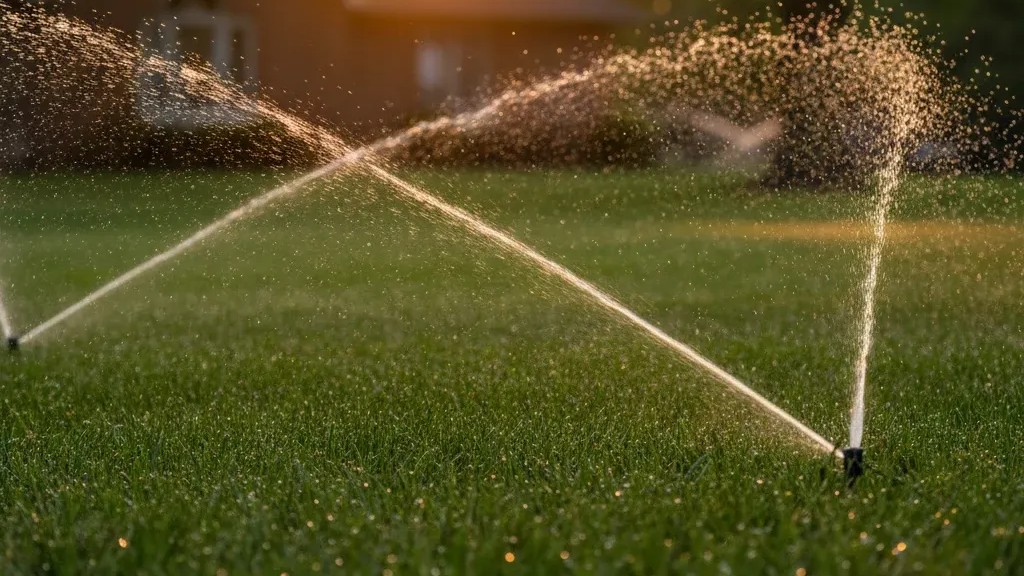
An underground sprinkler system holds water in its pipes, valves and heads long after the last watering. When that water freezes, it can crack parts you will not see until the system runs again in spring.
Sprinkler system winterization clears that water out before the ground freezes. It is part of the seasonal care our Greater Lansing, MI landscaping company provides for homes and businesses.
Here's what you need to know before the first hard freeze.
What Freezing Water Does to Sprinkler Lines
Water grows as it turns to ice. Colorado State University Extension says it expands by about one-eleventh of its volume, enough to burst pipes and fittings and crack valves.
The damage usually stays hidden until spring start-up. Then it shows up as a soggy patch, a geyser at one head or a zone that will not hold pressure.
Why Draining by Gravity Often Falls Short
Some systems have manual or automatic drain valves at low points. Colorado State's guidance is blunt: do not trust them, because buried pipe shifts over time and water settles in low spots.
The same guide calls compressed air the only sure way to push enough water out. Systems with electric valves need it, since water cannot drain from the top of the valve diaphragms.
How a Professional Blowout Works
A blowout sends air through one zone at a time until the heads spray only mist. Pressure matters, since too much can blow nozzles off or overheat pipe.
Colorado State lists 80 psi as the limit for rigid PVC and 50 psi for flexible poly pipe. Volume matters too, and the University of Minnesota notes most home compressors move far less air than commercial units.
Protecting the Backflow Preventer
The backflow preventer usually sits above ground near the house, so it faces the coldest air. After draining, its ball valves and test cocks are left partly open, at about a 45-degree angle, so trapped water has room to escape.
The University of Minnesota also suggests foam insulation or a backflow blanket on exposed pipe. Both steps help keep this part from cracking.
What to Do With the Controller
Shutting off the water does not mean unplugging the timer. Colorado State recommends keeping the controller powered so heat from its transformer helps keep out moisture and corrosion.
Set it so no zone tries to water through the winter, while it stays plugged in.
Use the Shutdown to Spot Problems
The last run of the season is a good time to check every zone. Broken heads, clogged nozzles and leaks are easier to flag now than to find in a brown lawn next July.
Our irrigation installation and repair crews handle winterization, spring start-up and repairs. That pairs well with residential landscape maintenance and our wider residential landscaping services.
A well-tuned system also helps with drought-tolerant landscaping, where watering deeply and less often counts. Business owners lining up winter work can pair a blowout with commercial snow and ice planning.
Frequently Asked Questions
When is the right time to blow out a sprinkler system?
Plan it for fall, after the last mowing-season watering and before temperatures stay below freezing. Waiting for the first hard freeze risks ice already forming in shallow lines and exposed pipe.
The University of Minnesota points to fall as the time to start, because water left in the system can freeze and lead to burst pipes. Booking ahead keeps the job off the coldest weeks.
Can a home air compressor handle a sprinkler blowout?
Most home compressors can reach the needed pressure but move far less air per minute than commercial units. That means slower drying and a higher chance that water stays in low spots.
The University of Minnesota recommends a certified irrigation professional with commercial equipment as the safest route. Too much pressure can also pop nozzles or overheat pipe, so the gauge matters as much as the tank.
Does Redwood Landscaping winterize commercial irrigation systems?
Yes. Redwood Landscaping lists winterization and spring start-up among its commercial irrigation services, along with sprinkler head repair, controller programming and upgrades, water efficiency audits and backflow prevention testing.
Those services are offered to commercial properties in Okemos, Lansing, East Lansing and throughout Michigan. Residential sprinkler customers can also get seasonal maintenance and winterization.
What happens when the sprinkler system is turned back on in spring?
A spring start-up turns the water back on, then checks each zone for broken heads, leaks and coverage gaps. It is the first chance to see whether anything froze over the winter.
Redwood Landscaping pairs winterization with spring start-up for commercial irrigation, so the same crew that drained the system brings it back online.
Should the backflow preventer be covered for winter?
Yes, if it sits above ground. Foam pipe insulation or a backflow blanket helps protect exposed pipe and fittings from the coldest nights.
Covering it is not a substitute for draining it. The University of Minnesota advises setting the ball valves and test cock screws at a 45-degree angle first, so trapped water can drain before the cover goes on.